Fall HVAC Guide: Furnace Troubleshooting and AC Installation in Layton, UT
Smelling burning dust on the first freezing night? See what startup noises are normal with these home maintenance tips and troubleshooting before winter hits.


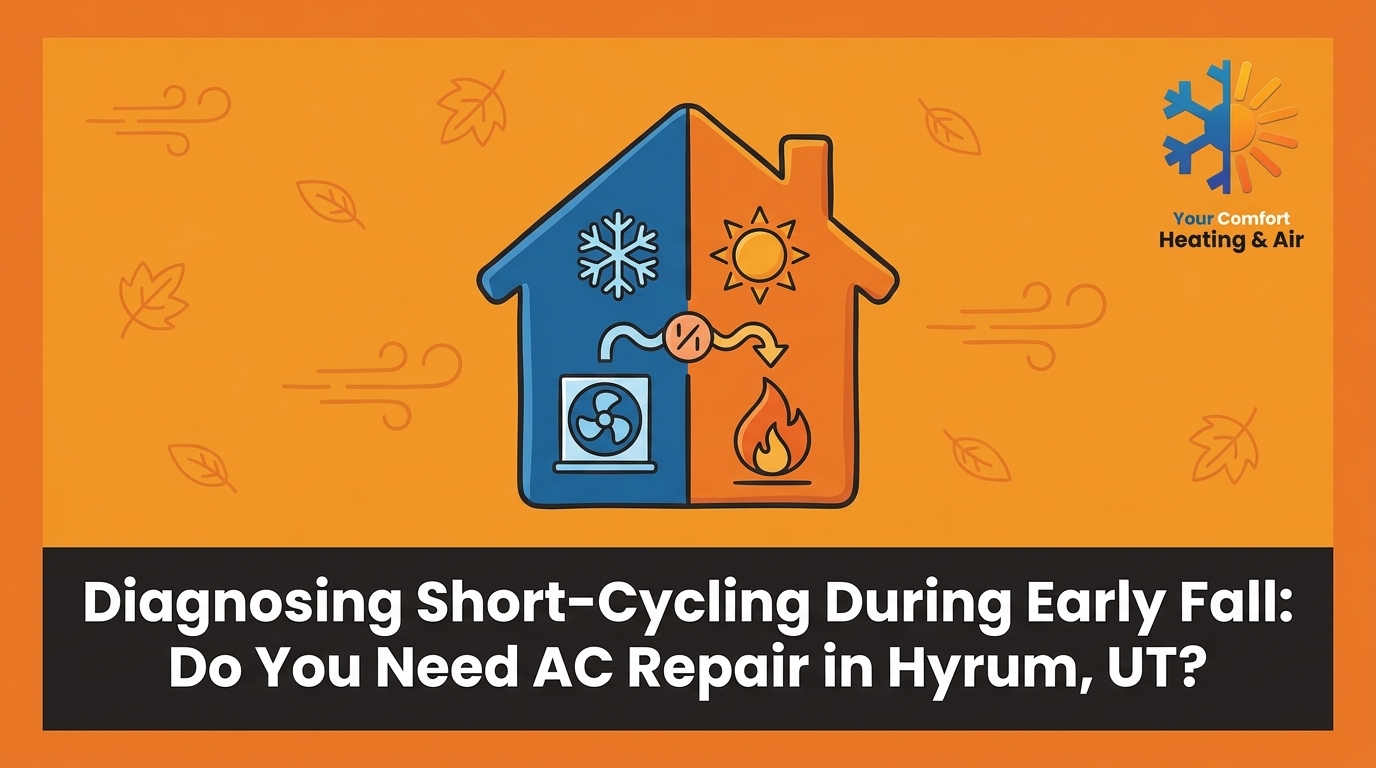
When Diagnosing Short-Cycling During Early Fall: When Your Hyrum Home Needs Both Heating and Cooling in the Same Day, you likely experience a furnace running nonstop at 6:00 a.m., only to wonder by 4:00 p.m. if you need AC installation in Hyrum or just a simple repair to survive the sweltering afternoon heat. Waking up to freezing temperatures and returning home to a baking house is incredibly frustrating, especially when your climate control equipment seems confused by the rapid shifts. This mechanical confusion often leads to short-cycling, a condition where your unit rapidly turns on and off without ever completing a full cycle. Whether you need comprehensive heating services to prepare for the upcoming winter or are trying to keep your current cooling setup alive, understanding how your system handles these wild daily temperature shifts is the first step.
During the September early fall transition, older residential units face an immense amount of operational strain. They are suddenly forced to perform two completely different jobs within a twelve-hour window. While some minor thermostat adjustments can ease the burden on your equipment, persistent erratic cycling requires professional attention to avoid a total mechanical failure. By understanding the unique ways our high-desert climate stresses your home's infrastructure, you can make informed decisions about when to adjust your habits and when to call a technician.
To understand why your equipment struggles so much this time of year, you have to look at the specific meteorological phenomena in Cache Valley. Our high-desert geography leads to rapid nighttime heat loss. Without a thick blanket of humidity to hold the previous day's warmth, temperatures plummet as soon as the sun goes down. This creates the extreme diurnal temperature shifts typical of the region, where freezing mornings rapidly turn into hot, sun-baked afternoons.
In Hyrum and throughout Northern Utah, it is not uncommon to see a 40- to 50-degree temperature swing in a single day. Intense afternoon solar heat gain bakes the roof and western-facing walls of your home, forcing the interior climate control to switch from heating mode to cooling mode within a remarkably short window. This specific climate pattern creates one of the most demanding environments in the country for residential comfort systems.
• 6:00 AM — Typical Temperature: 35°F - 45°F — System Mode: Heating — Operational Strain: High demand to recover from nighttime heat loss
• 12:00 PM — Typical Temperature: 65°F - 70°F — System Mode: Idle / Transition — Operational Strain: System shuts down, residual heat remains in ducts
• 4:00 PM — Typical Temperature: 80°F - 85°F — System Mode: Cooling — Operational Strain: Rapid start-up required against intense solar heat gain
Most homeowners assume that July and August are the hardest months on their equipment. However, summer requires continuous cooling, which is a steady, predictable operational load. The unit turns on, runs for a long cycle, and turns off. Fall, on the other hand, forces the system to constantly toggle modes. For heat pumps, this means the reversing valve must physically shift back and forth daily. For traditional split systems, it requires entirely different mechanical components—the furnace burner and the outdoor compressor—to engage back-to-back, leaving no time for the system to equalize.
The Problem: You hear your unit kick on, but less than five minutes later, it shuts down again. A few minutes pass, and the cycle repeats. This is short-cycling. It occurs when an HVAC system turns on and off rapidly before completing a full heating or cooling cycle, preventing your home from ever reaching the desired temperature.
The Cause: Rapidly switching modes during the September early fall transition can easily confuse older thermostats or cause limit switches to trip due to residual heat or pressure. For example, if your furnace runs heavily in the morning, the heat exchanger gets incredibly hot. If the thermostat suddenly demands air conditioning a few hours later, the blower motor pushes air over a still-warm heat exchanger. The system's internal sensors read this conflicting data, assume there is an overheating or pressure issue, and immediately shut the compressor down as a safety precaution.
The Solution: Modern, variable-speed systems are designed with advanced control boards that handle toggling much better. However, older single-stage units in Northern Utah are highly susceptible to this mechanical stress. The solution involves giving the system adequate time to equalize between modes. This rapid on-and-off cycling places immense strain on the compressor and heat exchanger, significantly increasing your energy consumption and putting the unit at risk of premature failure if not addressed.
While rapid temperature swings trigger short-cycling, the problem is almost always made worse by a common maintenance oversight: restricted airflow. When your system is already struggling to balance heating and cooling demands, a dirty air filter acts as a physical barrier that suffocates the blower motor.
Restricted airflow causes the system to overheat quickly in heating mode or freeze up entirely in cooling mode. When the blower cannot push enough air over the heat exchanger, the internal temperature of the furnace spikes. This triggers the high-limit switch, a safety device designed to shut the burners down before a fire hazard occurs. Once the unit cools off a few minutes later, it tries to fire up again, resulting in a continuous loop of short-cycling.
In Hyrum and Northern Utah, early fall is the most critical time to check your airflow. Lingering summer dust, agricultural harvesting debris, and late-season wildfire smoke quickly clog standard filters. Understanding how dirty furnace filters impact air quality and system performance is vital. Swapping out a clogged filter is a simple, inexpensive maintenance task that can often prevent a costly, stressful breakdown during unpredictable weather.
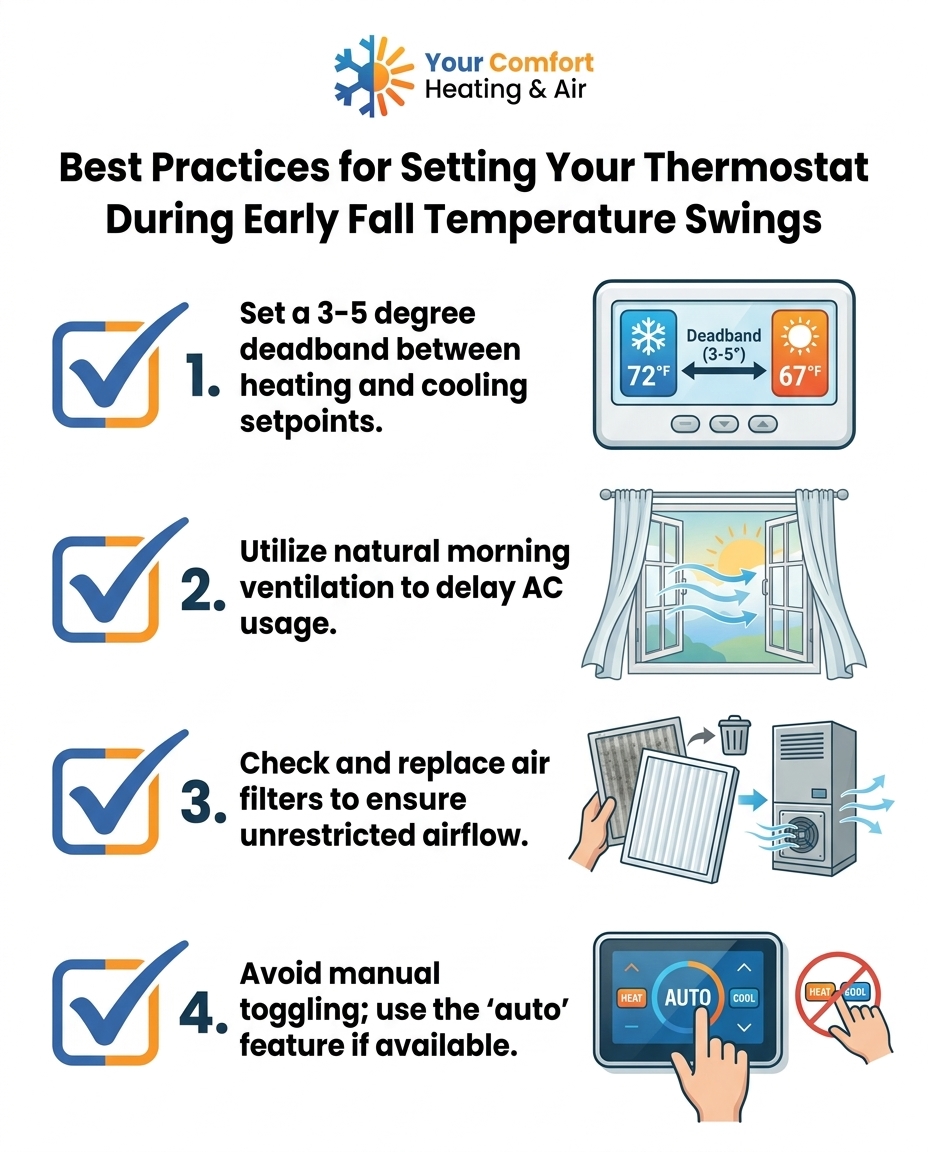
Managing your indoor comfort during the September early fall transition requires more than just picking a single number on the dial. Because of our deep roots in the region, we provide localized Northern Utah expertise, understanding exactly how the high-desert climate strains systems. We recommend specific, localized thermostat habits rather than generic advice to help your equipment survive the seasonal shift.
1. Set a wider deadband: The deadband is the temperature difference between your heating and cooling setpoints. If you set your heat to 70°F and your cool to 72°F, the system will constantly fight itself. Widen that gap to at least 5 to 7 degrees (e.g., heat at 68°F, cool at 75°F) so the unit has a buffer zone where it can simply rest.
2. Avoid manual toggling: Resist the urge to manually flip the switch from "Heat" to "Cool" multiple times a day. If your thermostat has an "Auto" feature, use it in conjunction with a wide deadband. This allows the system's internal logic to manage the transition safely.
3. Utilize natural ventilation: Take advantage of the cool, crisp mornings. Open your windows to flush the house with cool air early in the day, then close the windows and blinds by mid-morning. This delays the need to turn on the air conditioner until much later in the afternoon, reducing the operational load.
4. Upgrade to a smart thermostat: Older mechanical thermostats struggle with rapid daily temperature swings. A modern smart thermostat uses algorithmic learning to anticipate the afternoon heat based on local weather data, gradually adjusting the indoor climate without shocking the system.
There is a clear line between tweaking your thermostat habits and needing professional intervention. If you have widened your deadband, replaced the air filter, and allowed the system time to rest, but the unit is still turning on and off every five minutes, you have a mechanical issue that requires a licensed technician.
Watch for warning signs that go beyond basic thermostat settings. Loud clicking noises from the cabinet, a faint burning smell, or the system failing to turn on entirely are clear indicators of component failure. One local homeowner reached out during the fall when their furnace suddenly stopped working after a period of erratic cycling. A technician was able to schedule an appointment immediately, safely isolate the problem, and have the heating restored within an hour. Ignoring rapid cycling often leads to sudden, total system failure right when you need the equipment most.
Prompt professional diagnostics are essential to isolate whether the issue lies in the compressor, a faulty furnace limit switch, or a failing control board. A comprehensive evaluation of your HVAC system ensures that minor electrical hiccups don't snowball into catastrophic compressor failures.
Opening the cabinet to inspect limit switches, test refrigerant levels, or probe electrical components requires specialized training and licensing. Modern heating and cooling units contain high-voltage capacitors that hold lethal charges even when the power is turned off, as well as highly pressurized refrigerants that require EPA certification to handle. Professional diagnostics are the only safe, reliable way to address persistent short-cycling in Hyrum and Northern Utah.
Allowing an older unit to short-cycle continuously throughout the September early fall transition does cumulative, often irreversible damage to the machinery. Every time a compressor or blower motor starts up, it draws a massive surge of electricity and experiences intense mechanical friction. A system that starts up forty times a day instead of ten will burn out its internal components at an accelerated rate.
This constant starting and stopping also has a severe impact on your home energy bills. Starting the system up requires significantly more electricity than simply keeping it running. You end up paying higher utility costs for a home that never actually feels comfortable.
Addressing these issues now serves as a vital preventative measure for the harsh winter ahead. A professional tune-up can restore efficiency, recalibrate safety sensors, and bring stability back to older units, ensuring they are prepared for the deep freezes of January rather than limping through the autumn months.
Managing your indoor climate during the wild swings of a Hyrum and Northern Utah autumn doesn't have to be a daily battle. By widening your thermostat deadband, keeping a close eye on your air filters, and utilizing natural morning ventilation, you can alleviate much of the stress placed on your equipment.
However, when those adjustments aren't enough to stop the erratic on-and-off behavior, clear, safe guidance and professional support are always available. Do not let a struggling system leave you freezing in the morning and sweating in the afternoon. If your equipment continues to short-cycle despite your best efforts, schedule an inspection to protect your home, whether that means a simple tune-up or planning for a reliable new AC installation in Hyrum.
Can switching from heat to AC damage my system?
Switching directly from heat to AC without a resting period can strain older systems. It forces the internal components to reverse operations while residual heat is still present in the ductwork and heat exchanger. To prevent damage, always turn the system off for at least five to ten minutes before toggling to the opposite mode.
Why is my AC turning on and off every 5 minutes?
An AC turning on and off every few minutes is experiencing short-cycling, which is often caused by restricted airflow, a tripped safety switch, or a malfunctioning thermostat. Check your air filter first, as a clogged filter is the most common culprit. If a new filter doesn't resolve the issue, a professional diagnostic is required to prevent compressor damage.
What causes an HVAC system to short cycle in the fall?
Fall short-cycling is typically caused by the system struggling to manage extreme temperature swings, combined with dirty filters from summer usage. When the unit tries to heat a freezing morning house and cool a hot afternoon house, conflicting sensor readings or overheating components can force the system to shut down prematurely.
Is it bad to switch between AC and heat on the same day?
It is not inherently bad if your system is modern and you allow a sufficient buffer between modes. However, rapidly flipping back and forth manually can confuse the control board and strain the reversing valve or compressor. Using the "Auto" setting with a wide deadband is the safest way to manage daily transitions.
Why is my HVAC system turning on and off constantly in the fall?
Constant cycling during the fall usually indicates that the thermostat setpoints are too close together, causing the heating and cooling modes to fight each other. It can also point to a dirty flame sensor or a tripped high-limit switch. Widening the temperature gap on your thermostat is the best first step to troubleshoot the issue.
What is the ideal thermostat deadband setting for high-desert climates?
In high-desert climates with extreme daily temperature shifts, an ideal deadband is between 5 and 7 degrees Fahrenheit. Setting your heating to 68°F and your cooling to 74°F or 75°F gives the system a wide resting zone. This prevents the unit from overworking during the rapid transition from freezing mornings to hot afternoons.
Read what our satisfied customers have to say about our reliable HVAC services and expert solutions for home comfort and efficiency.





We’ve partnered with trusted lenders to offer flexible financing solutions that fit your budget. Whether you’re looking to start a new project or upgrade your home, we make it easy and affordable.Explore your options today and take the next step with confidence.