Fall HVAC Guide: Furnace Troubleshooting and AC Installation in Layton, UT
Smelling burning dust on the first freezing night? See what startup noises are normal with these home maintenance tips and troubleshooting before winter hits.


July in Northern Utah brings a brutal reality check, showing exactly how 100-degree days expose undersized AC units in Hyrum and the surrounding areas. You check the thermostat at 4 p.m., desperately hoping for relief, but it stubbornly reads 78 degrees. Your vents are blowing air, the unit outside is roaring, yet the house simply will not cool down. This is the exact moment many homeowners realize they aren't just dealing with a temporary glitch or a broken part. Instead, they are facing a fundamental capacity issue exposed by extreme weather.
If you are struggling with this exact scenario, you are left facing a tough choice: keep paying sky-high energy bills for a house that never feels comfortable, or invest in a properly calculated solution. Reaching out for professional Air Conditioning services and expert AC installation in Hyrum is the first step toward restoring your home's comfort.
The immediate frustration: A system that runs constantly without satisfying the thermostat feels broken. However, rapid temperature spikes in Northern Utah push cooling equipment to its absolute physical limits. When the outdoor temperature skyrockets, the amount of heat transferring into your home increases drastically. If your air conditioner lacks the sheer tonnage (cooling capacity) to remove that heat as fast as it enters, the indoor temperature will plateau or even rise, regardless of how flawlessly the internal mechanical parts are operating.
Many homeowners assume they just need a quick top-off of refrigerant or a new capacitor. While those issues certainly cause cooling problems, a system that works perfectly well on an 82-degree morning but completely fails to cool the house during 100-degree days is typically showing its true, undersized colors. Standard maintenance cannot fix a unit that is simply too small for the physical footprint and heat load of your home.
The problem: To understand why your home has an undersized unit in the first place, you have to look back at the original construction phase. Many homes in Hyrum received their first air conditioning systems based entirely on square footage. This "rule of thumb" sizing assumes that every 500 square feet of living space requires exactly one ton of cooling capacity, completely ignoring the unique characteristics of the actual house.
The cause: Square footage is only a two-dimensional measurement of the floor plan. It tells an installer absolutely nothing about the actual heat load the home experiences. A true cooling load is influenced by a massive variety of factors that a simple rule of thumb misses completely. Builder-grade sizing typically ignores:
• Sun exposure and orientation: A home with massive, unshaded west-facing windows will absorb significantly more solar heat in the late afternoon than a home shaded by mature trees.
• Insulation quality: The R-value of your attic and wall insulation dictates how much heat bleeds into your living space from the outdoors.
• Window efficiency: Single-pane or poorly sealed windows act as thermal bridges, allowing the peak July heat to bypass your walls entirely.
• Ceiling height and volume: Vaulted ceilings increase the total volume of air that must be cooled, which square footage calculations completely overlook.
The solution: These builder-grade systems often perform adequately during mild spring weather or early summer days. Because the heat load is relatively low, the undersized unit can keep up. However, this creates a false sense of security. When pushed beyond their design limits during extreme summer heatwaves, these flawed foundations fail spectacularly. No amount of standard maintenance, filter changes, or coil cleaning can force a two-ton air conditioner to do three tons of cooling work. Recognizing that an improperly sized unit is a structural flaw is the first step toward finding a permanent, comfortable solution.
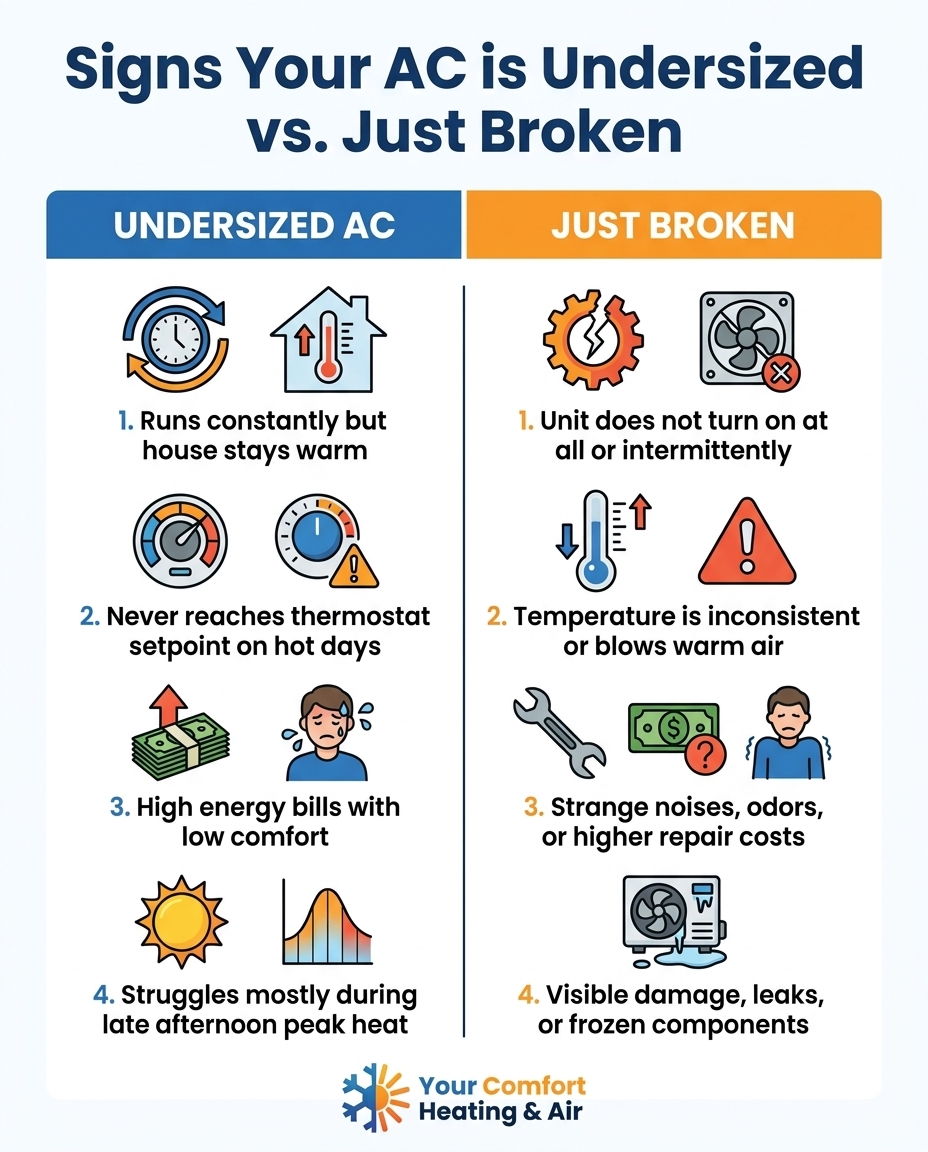
Diagnosing whether your system is fundamentally undersized or simply suffering from a mechanical failure requires observing its behavior during the hottest parts of the year. When peak July heat sets in, an undersized unit will display very specific, predictable symptoms. If you are noticing these patterns, it is time to look beyond basic repairs.
• Constant operation with no relief: The unit runs continuously for hours on end without ever reaching the thermostat setpoint during the hottest parts of the day. If you set it to 72 degrees and it stalls at 78, capacity is the likely culprit.
• High utility bills, low comfort: Your energy bills are unusually high because the system never cycles off, yet your home never feels truly comfortable or adequately dehumidified.
• Late afternoon struggles: The system cools the house perfectly well at 9 a.m. but struggles significantly more in the late afternoon as solar radiation peaks and the outdoor temperature climbs.
• Uneven cooling across the house: Certain rooms, especially those on the second floor or facing west, become unbearably hot because the system lacks the power to push conditioned air evenly throughout the entire ductwork network.
It is important to separate these capacity symptoms from standard mechanical failures that require standard repair services. A bad dual run capacitor, a failing blower motor, or a blown fuse will typically cause the system to stop blowing cold air entirely, or stop running altogether. An undersized unit, on the other hand, will continue to blow cold air—it just will not be enough cold air to overcome the heat entering the home.
We frequently see this play out when the weather spikes into the 90s and beyond. One local homeowner reached out during a recent extreme heatwave when their system completely gave up the ghost. A technician arrived the same day to diagnose the issue, providing an honest assessment of the system's capacity limits and offering good value without any high-pressure up-selling. Getting an accurate diagnosis is critical before investing in a replacement, which includes understanding SEER ratings and choosing a high-efficiency AC that actually fits your home's needs.
To truly grasp why a cooling system that worked perfectly in June suddenly fails in July, you have to understand the physics of HVAC engineering. Every air conditioning system is installed with a specific "design temperature" in mind. In simple terms, the design temperature is the maximum outdoor temperature a system is engineered to handle while successfully maintaining your desired indoor comfort level.
Many older or builder-grade systems were sized for average summer days—often around 85 to 90 degrees. They were never engineered for extreme, prolonged heatwaves. When the outdoor temperature hits triple digits, the heat transfer into the home accelerates. The heat bleeding through your roof, walls, and windows eventually exceeds the air conditioner's maximum removal capacity.
Northern Utah is known for high diurnal temperature variations—meaning the temperature swings wildly from cool mornings to scorching afternoons—paired with intense peak solar radiation during mid-summer. This rapid shift forces the AC to play catch-up. If the system lacks the necessary capacity, it simply cannot remove the heat fast enough. In these conditions, the system is actually doing exactly what it was sized to do; it is just that the original sizing was wrong for the region's actual climate extremes.
• Average Summer Day — Outdoor Temp: 85°F — System Behavior: Cycles on and off normally — Indoor Comfort: Reaches setpoint easily
• Peak Heatwave — Outdoor Temp: 100°F+ — System Behavior: Runs 100% of the time without stopping — Indoor Comfort: Stuck 5-8 degrees above setpoint
• Nighttime Recovery — Outdoor Temp: 75°F — System Behavior: Finally cycles off as outdoor heat drops — Indoor Comfort: Briefly reaches setpoint overnight
The takeaway: If your system only struggles when the temperature crosses a certain extreme threshold, you are experiencing a cooling load deficit, not a broken part.
The problem: Ignoring an undersized system doesn't just leave you sweating in your living room; it quietly drains your wallet month after month. A central air conditioner is designed to cycle on, cool the house, and cycle off to rest. When a unit is too small, it runs continuously, which creates a cascade of financial consequences for the homeowner.
The cause: Continuous operation leads to accelerated wear and tear on critical, expensive components. The compressor, which is the heart of your cooling system, takes the brunt of this abuse. Compressors generate their own heat while operating, and they rely on cycling off to cool down. When forced to run non-stop during peak July heat, the compressor overheats, the internal lubricating oils break down, and the lifespan of the entire unit is drastically shortened.
The strain of continuous operation often leads to late-day failures when you need cooling the most. For example, one local customer experienced a total system shutdown late in the afternoon because their overworked AC finally quit. A technician arrived at 4:30 PM and had to work continuously until 10:30 PM just to get the exhausted system back online. These types of emergency breakdowns are the direct result of a system being pushed beyond its limits.
The solution: Running a three-ton compressor for 14 hours straight consumes significantly more electricity than running a properly sized four-ton compressor for normal cycles. This leads to predictable utility bill spikes every single summer. Furthermore, the compounding cost of repeated breakdown service calls quickly adds up. Investing in a properly sized system offsets these ongoing, wasted expenses. If you are tired of paying for a system that doesn't work, exploring options for AC installation in Brigham City and the surrounding areas can provide a long-term financial remedy.
When it finally comes time to replace an undersized unit, the biggest mistake a homeowner can make is allowing a contractor to replace it "like for like." If your current three-ton unit cannot cool your home in Hyrum during a heatwave, installing a brand new three-ton unit will simply result in a brand new system that also fails to cool your home. This is why strict, honest load calculations are absolutely non-negotiable.
The Air Conditioning Contractors of America (ACCA) Manual J load calculation is the gold standard for the HVAC industry. Instead of guessing based on square footage, a Manual J calculation uses hard math and building science to determine exactly how much heat your home gains during the summer. As a local authority in home comfort, we refuse to guess. Every installation must be backed by precise calculations to handle local extremes, ensuring your investment actually solves the problem.
A thorough Manual J calculation takes dozens of variables into account, including:
1. Local Climate Data: Factoring in historical weather patterns, peak summer highs, and humidity levels specific to Northern Utah.
2. Home Orientation: Calculating the exact solar heat gain based on which direction your largest windows face.
3. Thermal Envelope: Measuring the R-value of your attic insulation, wall insulation, and the quality of your weatherstripping.
4. Occupancy and Appliances: Accounting for the heat generated by the people living in the home and large appliances like ovens and dryers.
Reassuringly, precise sizing guarantees reliable cooling even on the hottest days of the year. By treating the home as a complete thermal system, a proper calculation ensures your new unit has the exact capacity needed to keep you comfortable. If you want to ensure your next system is sized perfectly, scheduling professional AC installation in Perry or your specific neighborhood is the best way to secure peace of mind.
The most obvious sign is a system that runs continuously but fails to lower the indoor temperature during hot weather. You will likely notice that the AC works fine in the morning but loses ground in the late afternoon. Additionally, skyrocketing energy bills combined with a house that never feels fully comfortable strongly point to an undersized unit. A professional load calculation can confirm this definitively.
This usually means the heat entering your home is exceeding the cooling capacity of your equipment. While it could be a mechanical issue like a refrigerant leak or a dirty evaporator coil, during extreme heatwaves, it often means the unit is simply too small. The system is doing its maximum amount of work, but that maximum is not enough for your specific square footage and insulation levels.
Yes, but usually only after the sun goes down and the outdoor temperature drops significantly. An undersized unit relies on the ambient outside temperature cooling off to finally catch up and reach the thermostat setpoint. During the peak heat of the day, it will remain stuck several degrees above what you have requested.
An AC that is too small will run non-stop, leading to highly inflated electricity bills and accelerated wear and tear on the compressor. This constant operation drastically shortens the lifespan of the equipment and leads to frequent breakdowns. Ultimately, you pay more money in operational costs for a home that is never truly comfortable.
A Manual J calculation cannot fix your existing unit, but it is the critical first step in replacing it correctly. The calculation provides the exact mathematical data needed to select the right size for your new system. By performing this calculation, you ensure that your next air conditioner will have the precise capacity to handle peak summer heat without short-cycling or running constantly.
Extreme heat significantly impacts capacity because an air conditioner's job is to move heat from inside to outside. When the outside air is 100 degrees or more, it becomes physically harder for the system to release the heat it absorbed from your home. This forces the system to work longer and harder, exposing any underlying sizing deficits that might go unnoticed during milder weather.
You shouldn't have to choose between paying outrageous energy bills and sitting in a sweltering living room. If your current system is failing to keep up with the intense summer heat, it is time for a permanent fix based on real math, not guesswork. Schedule your comprehensive load calculation and system evaluation today to get a clear, honest explanation of your options and finally enjoy reliable cooling all summer long.
Read what our satisfied customers have to say about our reliable HVAC services and expert solutions for home comfort and efficiency.





We’ve partnered with trusted lenders to offer flexible financing solutions that fit your budget. Whether you’re looking to start a new project or upgrade your home, we make it easy and affordable.Explore your options today and take the next step with confidence.