Fall HVAC Guide: Furnace Troubleshooting and AC Installation in Layton, UT
Smelling burning dust on the first freezing night? See what startup noises are normal with these home maintenance tips and troubleshooting before winter hits.


When the back-to-school transition hits and your cooling system starts struggling with the afternoon heat, Navigating Late-Summer AC Breakdowns: Why We Tell Layton Homeowners Not to 'Just Wait Until Next Year' becomes our most important piece of advice. As the days begin to shorten but temperatures remain uncomfortably high, many homeowners face a frustrating mechanical crossroads. When a cooling system starts making strange noises, blowing warm air, or running constantly without actually lowering the indoor temperature, the immediate reaction is often avoidance. The temptation to simply shut the compromised unit down and ignore it until spring is incredibly strong.
It is a common homeowner decision point: endure the remaining few weeks of heat, turn off the thermostat once the autumn chill arrives, and defer the repair costs until the following year. On the surface, this logic seems sound. If the machine is turned off, it cannot sustain further damage, right? Unfortunately, as our team at Your Comfort Heating & Air has seen time and time again, this is a dangerous misconception. Turning off a compromised unit for the winter does not pause the mechanical and chemical degradation occurring inside the system.
When you leave a damaged system sitting idle, you are not hitting a pause button; you are allowing minor wear and tear to compound in the background. Proactive intervention is absolutely critical to preserving the lifespan of your equipment. To ensure your home stays comfortable and your equipment remains protected, securing professional Air Conditioning diagnostics and maintaining an active AC Maintenance Plan are the best defenses against catastrophic off-season failures.
There is a persistent myth that shutting down an air conditioning system protects it from further harm, even when an underlying issue exists. The reality of HVAC physics tells a very different story. A healthy unit is designed to sit dormant safely. A compromised unit, however, is highly vulnerable to the elements and internal chemical changes when left unaddressed in Layton and surrounding Northern Utah areas.
When a system operates with pre-existing wear—such as low refrigerant, failing electrical contacts, or restricted airflow—the internal pressures and temperatures fall out of balance. Simply removing power from the unit does not restore this balance. Instead, it traps the system in a compromised state. Our technicians frequently notice that minor issues in late summer continue to evolve mechanically and chemically throughout the winter months. The absence of operation simply means the absence of immediate symptoms, not the absence of degradation.
To understand why this happens, it helps to look at the differences between a normal end-of-season shutdown and a compromised one. When you invest in comprehensive HVAC services to stabilize the unit before the cold weather sets in, the system is sealed, balanced, and prepared for dormancy.
• Healthy Shutdown — Winter Condition: Refrigerant lines sealed; electrical components stable and dry. — Spring Startup Result: Smooth operation; normal energy consumption.
• Compromised Shutdown — Winter Condition: Moisture intrudes through micro-leaks; capacitors degrade in cold. — Spring Startup Result: Hard starting; potential compressor lock-up; high repair bills.
Internal pressures and ambient outdoor conditions interact constantly with damaged components. If a seal is weakened or a motor is already strained, the long winter freeze will only exacerbate that weakness, turning a small late-summer fix into a massive spring replacement project.
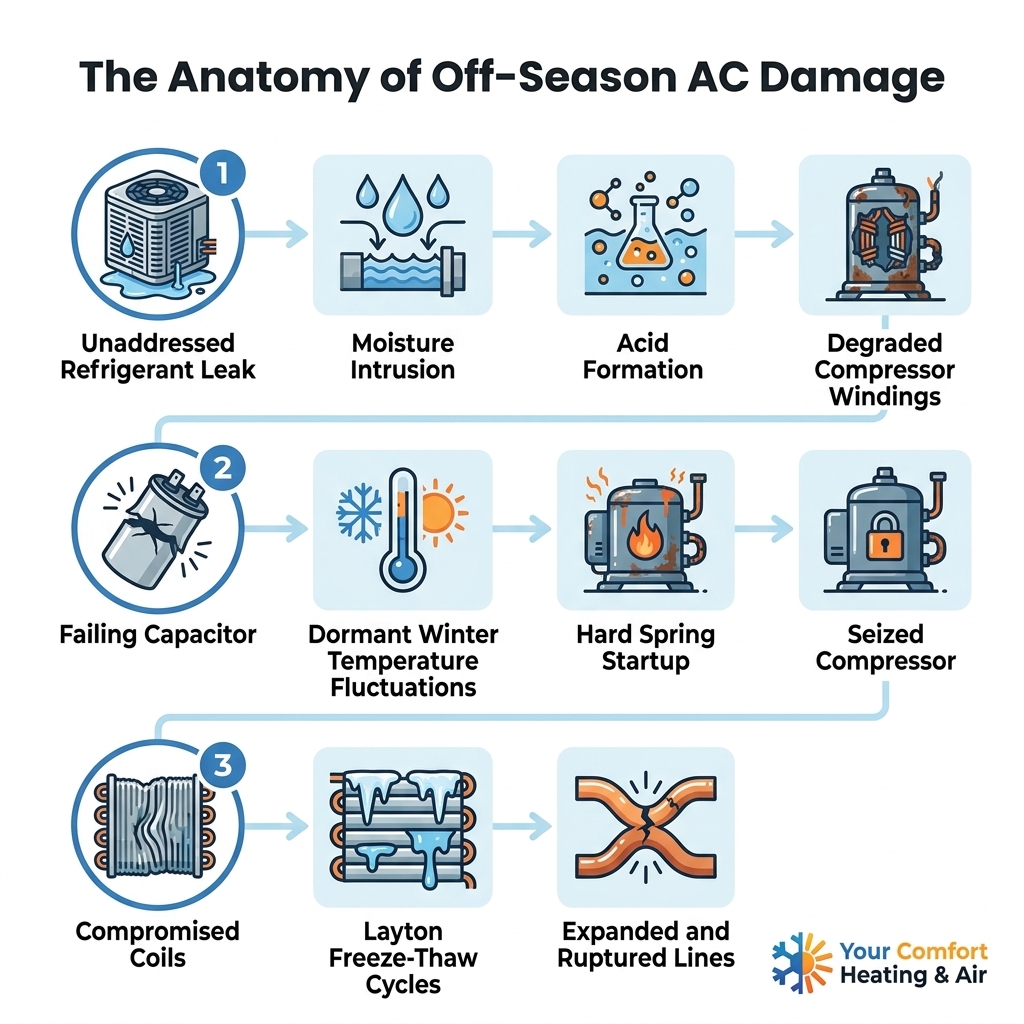
One of the most destructive scenarios our team encounters involves leaving a minor refrigerant leak unfixed over the winter. Many homeowners assume that a slow leak just means they will need to add more refrigerant next year. However, a refrigerant leak is a two-way street: while refrigerant is escaping into the atmosphere, atmospheric moisture is entering the system.
During the late-August back-to-school transition, this moisture intrusion might not immediately stop the system from running, but the clock starts ticking the moment the unit is turned off for the season. The internal environment of an air conditioner must remain completely free of water vapor. When moisture enters, it initiates a devastating chemical reaction.
The breakdown process inside the system follows a specific, predictable path when left dormant:
1. Moisture Absorption: The compressor oil inside the unit is highly hygroscopic, meaning it actively attracts and absorbs the moisture that leaked in from the outside air.
2. Chemical Hydrolysis: Over the long winter months, the trapped moisture mixes with the residual refrigerant and the compressor oil, triggering a chemical reaction known as hydrolysis.
3. Acid Formation: This reaction produces highly corrosive acids that circulate throughout the dormant system.
4. Internal Corrosion: The acid slowly eats away at the protective insulation on the compressor motor windings, destroying the electrical integrity of the system from the inside out.
In a recent late-summer service call in Layton, our Your Comfort Heating & Air technicians arrived to diagnose a struggling system that was missing critical valve caps. By diagnosing the problem immediately, suggesting a clear solution, and educating the homeowner on repair decisions, we serviced the unit professionally before the end of the season. This proactive step prevented the exact type of dormant moisture intrusion that silently destroys compressors over the winter.
Refrigerant leaks are not the only hidden danger. Failing electrical components, specifically capacitors and contactors, pose a massive risk when left dormant. During the heavy cooling loads of late summer in Layton and surrounding Northern Utah areas, capacitors work overtime to provide the massive jolt of electricity required to start the compressor motor.
When a capacitor begins to fail, it loses its ability to store and deliver that necessary electrical charge. If you notice the following symptoms before shutting the unit down, your electrical components are likely compromised:
• Clicking or humming noises: The unit attempts to start but struggles to engage the compressor.
• Delayed cooling: The fan runs, but warm air blows for several minutes before the air finally cools.
• Frequent breaker trips: The system is pulling too much amperage because the capacitor is weak.
If a weakened capacitor is left in the outdoor unit over the winter, the internal materials degrade further due to temperature fluctuations. When spring arrives and the thermostat calls for cooling, the degraded capacitor fails to deliver the necessary torque. This creates a "hard start" phenomenon. The compressor motor attempts to turn but cannot, causing it to overheat rapidly. This sudden, massive electrical and physical stress can cause a perfectly good compressor to seize up permanently upon the very first spring startup attempt.
The mechanical risks of deferred maintenance do not exist in a vacuum; they are heavily influenced by local geography. Layton's specific winter climate introduces freezing temperatures that cause condensation and freeze-thaw expansion inside outdoor AC units that are already compromised from summer wear. The transition from high late-August heat to the freezing winter temperatures typical of Northern Utah creates a brutal environment for weakened metal and loose connections.
The role of condensation: When an air conditioner is running poorly, it often struggles to manage humidity, leading to excess condensation within the cabinet. If the drainage systems are partially clogged from summer debris, this water remains trapped inside the base pan.
The freeze-thaw expansion: As winter sets in, this trapped water freezes and expands. Ice exerts tremendous physical force. If a refrigerant coil or a copper joint is already weakened from vibration or minor corrosion, the expanding ice can easily warp or rupture the metal. This physical stress multiplies the summer wear exponentially.
Units operating optimally and maintained properly are sealed and cleared against this type of damage. Their drain pans are empty, their coils are clean, and their electrical connections are tight. However, units with deferred maintenance are highly vulnerable in Layton and surrounding Northern Utah areas, making end-of-season diagnostics a necessity rather than a luxury.
All of these technical issues—acid formation, electrical degradation, and freeze-thaw expansion—synthesize into one ultimate consequence: catastrophic failure requiring a complete unit replacement. Picture the first hot day in spring when you finally turn the thermostat back to "cool." You expect the familiar hum of the fan and the rush of cold air. Instead, the compounded dormant damage culminates in immediate compressor failure.
When AC issues make it difficult to survive hot weather, a prompt resolution is the only way to restore comfort. But beyond immediate relief, professional intervention stops the mechanical bleeding. Without it, a minor late-summer repair easily escalates into needing a full AC installation in Layton. The acid has ruined the motor windings, the degraded capacitor forces a hard start, and the ruptured coils vent whatever refrigerant was left. The compressor locks up permanently.
We frequently trace spring compressor failures directly back to unaddressed late-summer issues. During the late-August back-to-school transition, a simple capacitor replacement or a minor leak patch could have saved the entire system. Instead, the unit sat idle while the damage multiplied.
This is where our real-world expertise at Your Comfort Heating & Air makes a difference. Our team routinely diagnoses and fixes compounding compressor damage caused by deferred maintenance, focusing on educating the customer on the actual mechanics of the system rather than relying on generic sales pitches. Honest, educational service calls prevent these catastrophic failures. If our professional diagnostic determines that a neglected system is already beyond repair, understanding SEER ratings for high-efficiency ACs becomes the next necessary step to ensure your replacement unit delivers optimal performance and savings.
Waiting until spring is highly discouraged because it allows existing mechanical issues to worsen significantly. While the unit sits dormant, temperature changes and trapped moisture cause corrosion and component degradation. A minor repair deferred in late summer often transforms into a major compressor failure by the time you turn the system back on in the spring. Addressing issues immediately preserves the equipment.
Yes, leaving a broken AC exposed to winter elements is very harmful to the internal components. Dormant, broken units are highly susceptible to acid formation in the compressor oil and the seizure of weakened electrical parts. The freezing temperatures in Layton and surrounding Northern Utah areas also cause trapped condensation to expand, which can rupture weakened coils and joints.
An unaddressed refrigerant leak creates a dangerous two-way exchange within your system. While the chemical refrigerant escapes into the atmosphere, corrosive moisture from the outside air is pulled into the system. This moisture mixes with the compressor oil to form acids that eat away at the electrical windings, eventually destroying the compressor motor from the inside out.
While the unit is physically powered off, chemical and environmental degradation continues uninterrupted. The absence of operation does not mean the system is safe; in fact, sitting idle allows acids to settle and rust to form on compromised parts. A broken AC should always be stabilized and sealed by a professional before being left dormant for the winter months.
Scheduling an end-of-season tune-up is one of the most effective ways to protect your investment. It catches minor wear and tear, clears out summer debris, and ensures the system is properly sealed against moisture before it sits idle. This proactive maintenance guarantees that your unit will start up smoothly and safely when the warm weather returns.
Do not let the relief of cooler weather trick you into ignoring a struggling air conditioner. As we have seen in our years serving Northern Utah, turning off a compromised unit during the late-August back-to-school transition does not pause the damage; it only allows moisture, acid, and mechanical stress to compound in silence. Addressing these issues right now is the only proven way to prevent catastrophic spring failures and protect the heart of your HVAC system.
Take action before the deep freeze sets in. Schedule a professional, neutral-expert diagnostic with our team to evaluate your system's health, and take advantage of an active maintenance plan to properly prepare your equipment for winter dormancy. By securing your system today, you ensure reliable, efficient cooling the moment you need it next year.
Read what our satisfied customers have to say about our reliable HVAC services and expert solutions for home comfort and efficiency.





We’ve partnered with trusted lenders to offer flexible financing solutions that fit your budget. Whether you’re looking to start a new project or upgrade your home, we make it easy and affordable.Explore your options today and take the next step with confidence.