Fall HVAC Guide: Furnace Troubleshooting and AC Installation in Layton, UT
Smelling burning dust on the first freezing night? See what startup noises are normal with these home maintenance tips and troubleshooting before winter hits.


Your air conditioner is running nonstop, but the vents are blowing stubbornly warm air. Then, an HVAC technician inspects the system and delivers a frustrating diagnosis: your system has lost its charge, and you need a brand-new unit. When your system fails during a peak Utah summer here in Brigham City, our team at Your Comfort Heating & Air believes you need the honest truth about refrigerant leaks and Freon recharging—not just a high-pressure sales pitch. Being handed a massive replacement quote without a clear explanation of your repair options is a highly stressful position for any homeowner.
Whether you need immediate Air Conditioning Services or just want to understand your options, knowing the mechanical facts puts you in control. The reality is that a refrigerant leak does not automatically mean your air conditioner is dead. However, depending on the age of your equipment and the type of refrigerant it uses, a simple repair might not be physically or legally possible. Deciding whether to patch the leak or replace the entire system requires an objective look at how air conditioners actually work, the specific location of the damage, and the long-term viability of the equipment. Here is exactly how we help our customers evaluate a leaking AC system so you can make a financially sensible decision for your home.
One of the most persistent misunderstandings we see in the HVAC industry is the idea that air conditioners simply "use up" their refrigerant over time. Many homeowners assume that adding a little Freon at the start of the summer is a normal part of home maintenance, similar to putting gas in a car or changing the oil. The short answer is that this is completely false. Your air conditioning system operates on a closed-loop circuit. The refrigerant travels back and forth between the indoor evaporator coil and the outdoor condenser, absorbing heat from inside your home and releasing it outside. Because it is a sealed loop, the chemical is never burned, consumed, or depleted.
If your system is low on refrigerant, there is only one possible reason: there is a physical hole, crack, or compromised joint somewhere in the copper lines or coils. "Topping off" a system without locating and fixing the underlying hole is a temporary, wasteful band-aid. The new refrigerant will simply leak out again—sometimes in a few months, sometimes in a matter of days. Beyond the wasted expense, running an air conditioner with a low charge causes severe mechanical damage. If you have an active HVAC Maintenance Plan with us, our technicians will check your refrigerant levels precisely to ensure the system isn't straining itself to death under heavy cooling loads.
The mechanical dangers of running a leaking AC system include:
• Compressor overheating: The compressor is the heart of your air conditioner, and it relies on the cool, returning refrigerant to keep its internal motor from overheating. When the charge is low, the compressor runs excessively hot, which can literally melt its internal electrical windings.
• Frozen evaporator coils: A drop in refrigerant pressure causes the temperature of the indoor coil to plummet below freezing. The natural humidity in your home's air will condense and freeze solid on the coil, blocking airflow entirely and sending liquid refrigerant back to the compressor—a fatal event known as "slugging."
• Continuous operation: During a peak Utah summer, the extreme heat load means a compromised system will run continuously without ever satisfying the thermostat. This accelerates wear and tear on the blower motor, the contactors, and the capacitors.
• Oil starvation: Refrigerant carries a specialized lubricating oil through the system. When refrigerant leaks out, the oil often leaks with it, leaving the compressor's mechanical parts grinding against each other without proper lubrication.
The most critical factor in determining whether a leak can be repaired is the type of chemical running through your system. For decades, the standard refrigerant used in residential air conditioning was R-22, commonly known by the brand name Freon. However, because R-22 is an ozone-depleting substance, the Environmental Protection Agency (EPA) mandated a gradual phase-out of the chemical. As of January 1, 2020, the production and import of R-22 became entirely illegal in the United States.
This regulatory shift completely changed the repair landscape for older units. If you are comparing pre-2010 R-22 systems vs modern R-410A systems, the differences are stark. Because new R-22 can no longer be manufactured, the only available supply comes from reclaimed and recycled quantities. As a result, the cost of sourcing R-22 has skyrocketed to the point where recharging an older, leaking system is financially prohibitive. If your system relies on R-22, the scale almost always tips toward replacement due to regulatory obsolescence, regardless of how small the actual leak might be.
• Refrigerant Availability — Pre-2010 R-22 Systems: Banned from production; highly scarce. — Modern R-410A Systems: Widely available and standard.
• Cost to Recharge — Pre-2010 R-22 Systems: Financially prohibitive due to scarcity. — Modern R-410A Systems: Standard service rate.
• Environmental Impact — Pre-2010 R-22 Systems: Ozone-depleting substance. — Modern R-410A Systems: Safer for the ozone layer.
• Operating Pressure — Pre-2010 R-22 Systems: Lower operating pressure. — Modern R-410A Systems: Much higher operating pressure.
• Repair Viability — Pre-2010 R-22 Systems: Rarely viable; replacement recommended. — Modern R-410A Systems: Highly viable depending on leak location.
You cannot simply drain an R-22 system and refill it with modern R-410A. The two chemicals operate at vastly different pressures and require completely different types of lubricating oil. Putting modern refrigerant into an older system would immediately rupture the compressor and destroy the unit. Therefore, when our team identifies a leak in an R-22 system, moving forward with an AC Installation in Ogden is generally the only responsible, long-term solution we can recommend.
A proper diagnosis requires finding exactly where the chemical is escaping. Without locating the hole, it is impossible to give an accurate repair estimate or make a sound recommendation. In our years of servicing homes across Brigham City, we know that finding a microscopic leak in a complex network of copper tubing requires specialized tools, strict safety protocols, and EPA certification. This is highly technical work, which is why our crew often performs it during comprehensive diagnostics or even during an AC installation for new construction to ensure the initial line sets are perfectly sealed.
Never attempt any DIY repairs on high-pressure refrigerant lines. Handling these chemicals without certification is illegal and highly dangerous, as the extreme pressures can cause severe frostbite or explosive injuries. Instead, our professionals use a multi-step process to pinpoint the exact location and severity of the failure.
1. Electronic Leak Detection: Technicians use highly sensitive electronic "sniffers" that detect the specific chemical signature of the refrigerant in the air. By slowly running the wand over the indoor coil, the outdoor condenser, and the connecting line set, the tool will beep rapidly when it encounters the escaping gas.
2. Visual Oil Inspection: Because refrigerant carries lubricating oil, a leak often leaves behind a greasy residue. Technicians will inspect all brazed joints, valves, and coils for dark, oily spots that indicate a breach in the copper.
3. UV Dye Injection: For extremely slow, microscopic leaks that evade electronic detection, a technician may inject a specialized ultraviolet dye into the system. The system is allowed to run for a few days, after which the technician returns with a UV flashlight. The dye will glow brightly at the exact site of the leak.
4. Nitrogen Pressure Testing: If the system is completely flat (empty), the technician will recover any remaining trace gas and pressurize the system with dry nitrogen. Nitrogen is safe, inert, and highly pressurized. The technician can then listen for an audible hissing sound or use a soap-bubble solution on the joints to watch for bubbling, which isolates the exact location of the failure.
The location of the leak dictates the repair strategy. A minor leak at an accessible valve or a poorly brazed joint on the exterior line set is usually a straightforward repair. The technician can recover the remaining refrigerant, braze the hole shut, pressure test the fix, and recharge the system. However, if the leak is located deep inside a heavily corroded indoor evaporator coil, repairing the individual hole is virtually impossible. The copper is likely degraded throughout, meaning the entire coil assembly must be replaced.
When you are handed a diagnosis of a refrigerant leak, you need an objective framework to evaluate your options. Rather than relying on a simple "yes or no" from a contractor, walking through a structured decision matrix ensures you are making the best financial choice for your home. Just this past July, our team helped a Brigham City homeowner who faced an AC breakdown during a brutal summer heatwave. We arrived the same day, diagnosed the problem, and walked them through these exact factors. The customer felt entirely comfortable with the repair decisions after being educated on the mechanics, proving to us once again that transparency is always better than pressure.
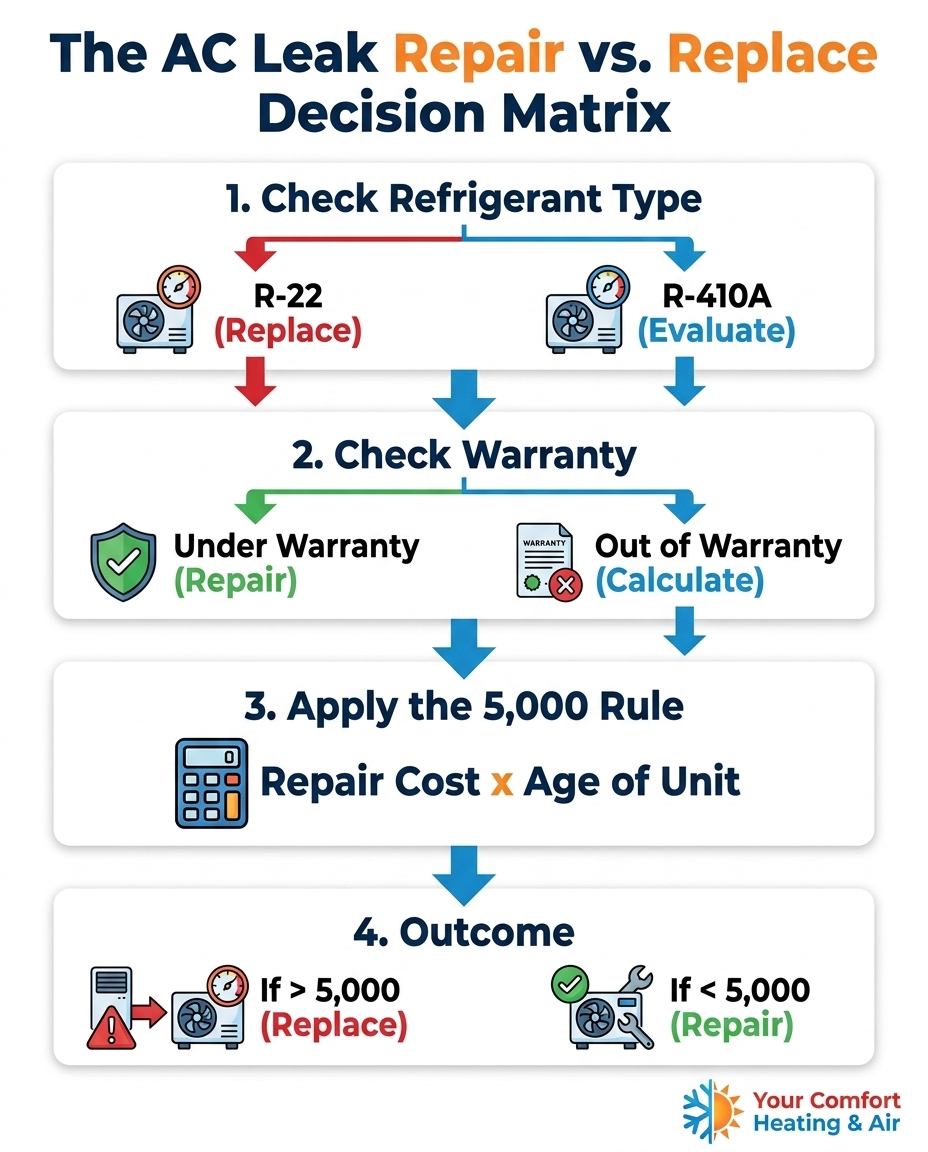
As discussed, the first dividing line is the chemical your system uses. If you are comparing pre-2010 R-22 systems vs modern R-410A systems, the path is usually clear. An R-22 system with a leak is effectively obsolete. The cost of the reclaimed chemical alone often exceeds the value of the aging equipment. If your system uses modern R-410A, a repair is mechanically possible and often highly cost-effective, moving you to the next factor.
Check the manufacturing date on the data plate of your outdoor unit. Most central air conditioners are designed to last roughly 12 to 15 years. If your modern R-410A system is less than ten years old, there is a strong chance the leaking component (such as the evaporator coil) is still covered under the manufacturer's parts warranty. If the part is under warranty, you only pay for the labor and the replacement refrigerant, making a repair the obvious choice. If the unit is completely out of warranty and approaching 15 years old, investing heavily in a repair is risky, as the compressor or blower motor could fail next.
An easily accessible leak on the copper line set connecting the indoor and outdoor units can usually be brazed and sealed quickly. However, if the leak is caused by formicary corrosion—a chemical reaction that creates microscopic pinholes across the entire indoor evaporator coil—patching it is not an option. You must replace the entire coil. Coil replacement is a major, labor-intensive repair that requires tearing down the indoor air handler.
Industry professionals, including our own technicians, often use a simple mathematical formula to help homeowners weigh the financial logic of a major repair. Take the total estimated cost of the repair (including labor, parts, and new refrigerant) and multiply it by the age of the equipment in years. If the resulting number exceeds 5,000, replacing the system is generally the smarter financial move. If the number is well under 5,000, repairing the unit makes sense. For example, a minor repair on an eight-year-old system will yield a low score, justifying the fix. A massive coil replacement on a twelve-year-old system will easily exceed the threshold, indicating that a new system is a better investment.
A refrigerant leak does not automatically mean a death sentence for your air conditioner. Unfortunately, some companies use the diagnosis of a leak as a high-pressure tactic to push a full system replacement, even when a repair is perfectly viable. This is why working with a transparent local contractor who prioritizes long-term value over an immediate up-sell is so critical. You deserve a clear itemization of the leak location, the exact repair costs, and alternative options.
During a recent July heatwave, another local customer called us late in the day when their AC completely failed under the heavy cooling load. One of our technicians started work in the late afternoon and stayed until late evening to get the AC working again, focusing strictly on resolving the immediate problem without pushing unnecessary upgrades. That level of dedication and honesty is exactly what you should look for in a service provider. Emphasizing transparency and integrity, a trustworthy local guide empowers the homeowner with facts rather than fear.
If a technician tells you that your system must be replaced immediately without showing you the exact location of the leak, explaining the condition of your coil, or checking your warranty status, you should absolutely seek a second opinion. A reputable company will gladly walk you through the diagnostic findings, take photos of the corrosion, and explain the math behind their recommendation. Whether our diagnostics lead to a targeted repair or an AC Installation in Brigham City, the decision should be made collaboratively, based on evidence and objective facts.
Yes, in our experience, most leaks can be physically repaired by brazing the hole or replacing the specific leaking component, provided the system uses modern refrigerant. If the leak is isolated to an accessible copper line or a single valve, a technician can seal the breach, pressure test the system, and recharge it safely. However, if the leak is caused by extensive corrosion across the entire evaporator coil, that specific part must be completely replaced rather than patched.
Because the system is sealed, adding refrigerant without fixing the hole means it will simply leak out again, wasting money and risking severe compressor damage. Air conditioners do not consume refrigerant as fuel; it merely circulates to absorb and release heat. "Topping off" a leaking system is a temporary band-aid that forces the equipment to run at improper pressures, which ultimately leads to catastrophic mechanical failure.
It depends on the unit's age, the type of refrigerant it uses, and the location of the leak. Modern systems with minor leaks are highly worth repairing, especially if the failing component is still under the manufacturer's warranty. Conversely, if the system is over 12 years old, uses obsolete R-22 refrigerant, or requires a massive indoor coil replacement, the repair costs rarely justify the investment compared to installing a new, efficient unit.
It is impossible to predict; depending on the size of the leak and system pressure, it could last a few months or leak out completely in a matter of days. High-pressure lines can force the chemical out rapidly, especially during a peak Utah summer when the system is running continuously. Relying on a recharge without a repair guarantees that the system will fail again, usually at the hottest and most inconvenient time.
Hissing sounds near the unit, ice buildup on the evaporator coil, longer cooling cycles, and air coming from vents that isn't cold are the primary indicators. You might also notice a sudden, unexplained spike in your monthly energy bills, as the compressor is forced to run nonstop to compensate for the lost cooling capacity. If you observe any of these symptoms, shut the system off immediately to prevent further damage to the compressor.
Navigating an AC breakdown is stressful, but understanding the mechanics behind the diagnosis removes the guesswork. Knowing the facts about your system's age, whether you are dealing with pre-2010 R-22 systems vs modern R-410A systems, and the exact location of the failure puts you firmly in control of the situation. You do not have to accept a full replacement quote blindly if a repair is mechanically sound and financially viable.
A transparent, objective assessment is the key to making the right financial decision for your home comfort. If your air conditioner is struggling to keep up or you have been told you have a leak, rely on a team that values honesty over the hard sell. Reach out to our experts at Your Comfort Heating & Air. We will thoroughly diagnose your system, present all viable repair and replacement options, and help you choose the path that makes the most sense for your home and budget.
Read what our satisfied customers have to say about our reliable HVAC services and expert solutions for home comfort and efficiency.





We’ve partnered with trusted lenders to offer flexible financing solutions that fit your budget. Whether you’re looking to start a new project or upgrade your home, we make it easy and affordable.Explore your options today and take the next step with confidence.