Fall HVAC Guide: Furnace Troubleshooting and AC Installation in Layton, UT
Smelling burning dust on the first freezing night? See what startup noises are normal with these home maintenance tips and troubleshooting before winter hits.


Your thermostat is set to 70°F, but the air coming out of your vents feels like a warm breeze. When your AC starts blowing warm air, getting common homeowner questions answered quickly is the best way to handle the situation before your house becomes unbearably hot. A sudden cooling failure is stressful, but taking a step-by-step approach helps you regain control of your indoor climate.
If you need immediate professional assistance, explore our air conditioning services or look into our preventative AC maintenance plan for long-term reliability.
At Your Comfort Heating & Air, we know firsthand that losing your air conditioning during a sudden July temperature spike is an immediate safety concern. The intense heat places immediate stress on your household, and a home's thermal envelope can trap that heat inside, raising indoor temperatures rapidly. The main decision point you face is identifying whether this is a simple homeowner fix—like adjusting a thermostat setting or changing a clogged filter—or a complex mechanical issue that requires a professional HVAC technician.
When a cooling system fails, guessing at the problem often leads to frustration. A sequential, neutral troubleshooting approach is the right next step. By ruling out the basic causes first, you save time, reduce stress, and avoid unnecessary diagnostic trips for a problem you could have solved in five minutes.
In our years serving Brigham City homeowners, one of the most frequent issues our team typically sees is a system that sounds like it is working perfectly, yet fails to lower the indoor temperature. To understand why this happens, you have to look at the basic mechanics of how your air conditioner removes heat. Your indoor unit contains an evaporator coil, which relies on a continuous flow of warm indoor air passing over it. The refrigerant inside the coil absorbs the heat from your air, and the cooled air is pushed back into your rooms.
According to U.S. Department of Energy data, a dirty air filter is the most common reason for HVAC system failure and reduced efficiency under load. When an air filter becomes severely clogged, it acts like a wall, stopping the necessary airflow. Without that warm air blowing over the indoor coil, the refrigerant drops below freezing. The natural humidity in your air then freezes directly onto the metal coils, turning your indoor unit into a block of solid ice. Once the coil freezes, no air can pass through it at all, resulting in weak, warm airflow at your vents.
Understanding Airflow Restrictions:
• Weak airflow from vents — Mechanical Cause: Clogged air filter blocking the blower motor — Immediate Action: Inspect and replace filter
• Warm air blowing steadily — Mechanical Cause: Frozen evaporator coil due to poor airflow — Immediate Action: Turn system off to thaw
• System runs constantly — Mechanical Cause: Thermostat set to 'On' instead of 'Auto' — Immediate Action: Adjust thermostat settings
Local geography plays a massive role in how fast this happens. In Brigham City, the dry summer climate increases the amount of airborne dust, pollen, and agricultural particulates circulating in the air, heavily impacting your indoor air quality (IAQ). Because of this heavy particulate load, the standard advice of changing your filter every 90 days is often obsolete. During peak cooling months, we recommend Brigham City homeowners check their filters every 30 to 45 days to prevent airflow restrictions and subsequent coil freezing.
One local homeowner recently experienced an AC failure during a stretch of 90-degree weather. Because the system completely stopped working in extreme heat, our technicians were dispatched the same day to restore comfort. However, before you make that call for service, you can run through a few safe, basic checks to see if the fix is simpler than you think. We believe in trusted local expertise, which means transparently teaching you how to avoid unnecessary service calls for simple issues like a flipped switch.
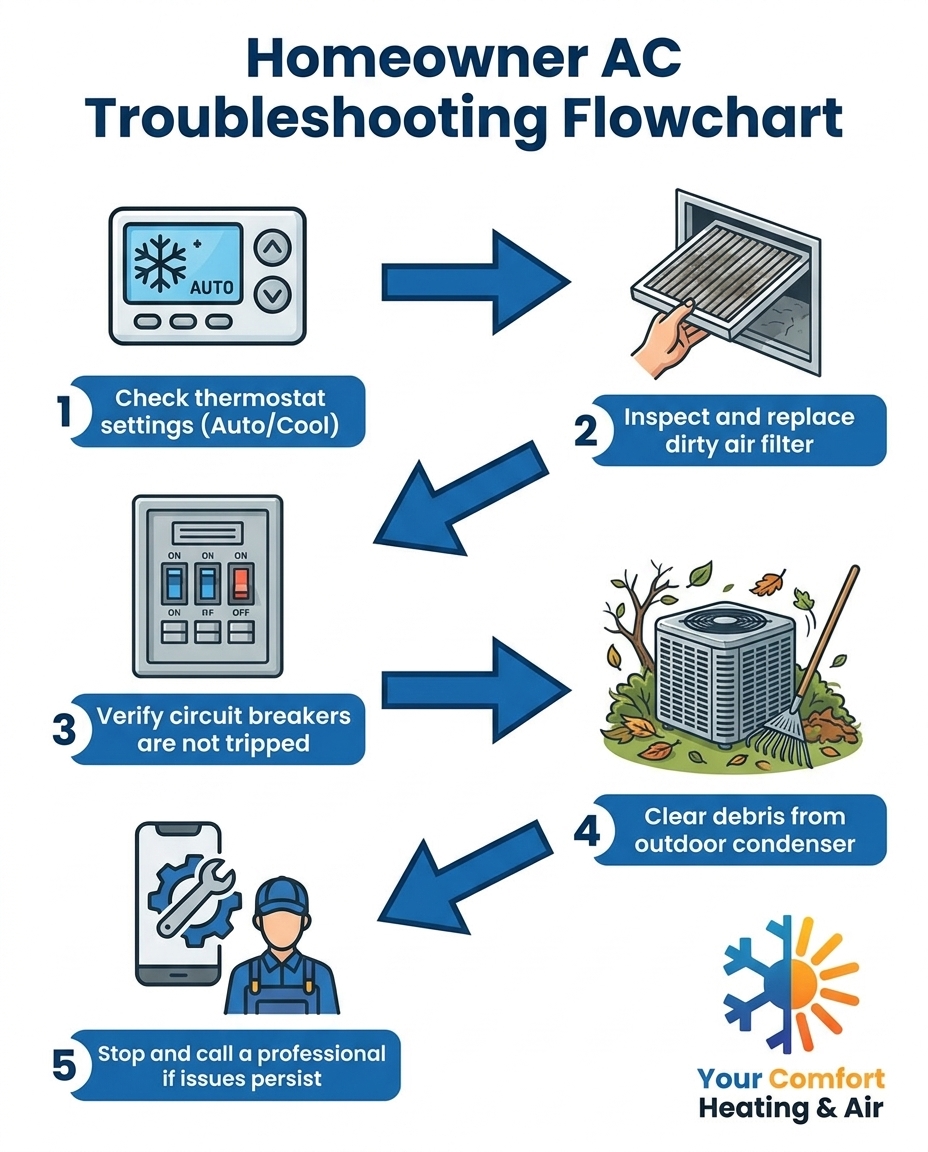
Follow this sequential triage checklist to safely evaluate your system:
1. Verify your thermostat settings: Ensure the system is actually set to "Cool" and that the temperature setpoint is below the current room temperature. Next, check the fan switch. It should be set to "Auto" rather than "On." If the fan is set to "On," it will blow air constantly, even when the outdoor compressor is not actively cooling the air, which feels like warm air coming from the vents.
2. Inspect and replace the air filter: Locate your return air filter. Pull it out and hold it up to a light source. If you cannot see light passing through the material, the filter is visibly coated in dust and must be replaced immediately.
3. Check the electrical panel: Locate your home's main circuit breaker box. Look for the breakers labeled for the AC compressor (outdoor unit) and the air handler (indoor unit). If a breaker has tripped, the switch will sit in the middle position. Push it firmly to the "Off" position, then push it back to "On."
4. Clear the outdoor condenser unit: Walk outside and inspect the metal box sitting in your yard. The condenser needs to pull air through its metal fins to release the heat it absorbed from your house. Ensure the unit is free of debris, leaves, tall grass, and physical obstructions. There should be at least two feet of clear space around the entire unit.
Keeping the summer cooling components clear of debris is a necessary seasonal responsibility to maintain peak cooling performance. If you complete these four steps and the system still fails to cool, it is time to stop and call a professional.
If your filter is clean and your thermostat is set correctly, but the air remains warm, you have likely crossed the line from a homeowner fix into professional repair territory. One of the most common mechanical failures our team addresses is a refrigerant leak. Refrigerant is the chemical fluid that transfers heat out of your home. It operates in a completely closed loop. It does not "burn up" or get consumed like gas in a car. If your system has low refrigerant levels, it always indicates a physical leak that must be located and repaired.
Common signs of low refrigerant include:
• Hissing or bubbling sounds: A distinct noise coming from the indoor coil or outdoor refrigerant lines indicates a high-pressure leak.
• Ice buildup on the indoor coil: Just like a clogged filter, low refrigerant causes the coil's temperature to drop below freezing, turning condensation into solid ice.
• Exceptionally long cooling cycles: The system struggles to reach the target temperature, running for hours without making the house comfortable.
Often, Brigham City homeowners mistake a refrigerant leak for a simple thermostat issue because the air coming out of the vents feels lukewarm. However, attempting DIY refrigerant repairs is dangerous. Handling these chemicals without certification violates EPA regulations and will void your manufacturer warranties. Only a licensed technician has the specialized gauges and recovery equipment to safely test the pressure and seal the leak. When exploring your options for older units that leak repeatedly, understanding SEER ratings for high-efficiency AC units can help you see why modern systems handle refrigerant much more efficiently and securely.
Sometimes, a temporary power fluctuation or a minor sensor glitch causes your air conditioner to lock itself out for safety. Resetting the unit can clear the error, but it must be done correctly to avoid damaging the compressor. Simply flipping switches rapidly can cause a massive electrical surge.
Here is the correct, safe sequence for resetting your AC unit:
1. Turn off the thermostat: Switch the thermostat from "Cool" to the "Off" position. This stops the thermostat from calling for cooling.
2. Locate the breaker: Go to your electrical panel and find the dedicated breaker for the outdoor AC unit.
3. Switch it off: Flip the breaker to the "Off" position.
4. Wait 30 minutes: This is the most critical step. You must wait a full half-hour before restoring power.
5. Turn it back on: Flip the breaker back to "On," then go inside and set your thermostat back to "Cool."
The 30-minute waiting period is non-negotiable. It allows the internal system pressures within the compressor to equalize. The compressor pushes refrigerant gas at extremely high pressures. If you cut the power and restart it immediately, the motor tries to start against maximum pressure, which draws massive amperage and can severely damage the equipment.
A strict safety warning: If you reset the breaker and it trips again immediately, do not reset it a second time. A repeatedly tripping breaker indicates a dead short or a grounded compressor, which poses a severe electrical fire risk. Repeated safety lockouts under heavy summer load always require a technician to investigate the root cause before the equipment is operated again.
When July temperatures soar, the heat inside a home can quickly become difficult to manage. One homeowner was struggling to cope with the extreme hot weather inside their house after a sudden cooling failure, and reaching out to our team for prompt assistance made the situation manageable again. Ignoring early warning signs—like strange noises, lukewarm air, or a system that constantly trips the breaker—almost always leads to a more extensive breakdown.
Running a struggling air conditioner places maximum thermal load on the internal components, particularly the compressor and the electrical capacitors. A capacitor acts like a battery, delivering a massive jolt of electricity to start the compressor motor. If the capacitor is failing, the compressor struggles to start, pulling excess amperage and overheating the internal motor windings.
This creates a dangerous domino effect. A failed capacitor is a relatively straightforward part for a professional to replace. But if you ignore the symptoms and force the system to keep running, that failed capacitor can easily lead to a catastrophic compressor failure, which is one of the most labor-intensive repairs in the HVAC industry.
July brings peak temperatures to Northern Utah, making rapid repair decisions critical for indoor safety. The physical toll on the machinery is highest when the outdoor temperature is highest. Rapid triage in Brigham City is critical during these heatwaves. Timely professional intervention often saves the system from catastrophic failure, catching small electrical or airflow issues before they destroy the primary cooling components.
If your system has failed entirely, or if a technician discovers a major issue like a cracked coil or a grounded compressor, you face the difficult decision of whether to repair the old unit or replace it entirely. A helpful approach our team at Your Comfort Heating & Air recommends is weighing the age of your equipment against the scope of the repair. If the repair is extensive and the unit is nearing the end of its lifespan, it is generally more practical to replace the unit rather than pour resources into failing technology.
Continuous repairs on an outdated unit drain your resources over time. Older units operate at much lower efficiency levels, meaning you consume more energy for less cooling power. Furthermore, preparing your home for July's peak-heat extremes requires reliable, updated equipment that won't leave you stranded during a severe summer weather event.
If you are unsure whether a repair is worth the investment, look for these three distinct signs that an upgrade is the smarter path:
• System age: The equipment is over 10 to 15 years old and uses outdated, phased-out refrigerant.
• Frequent breakdowns: You are calling for repairs multiple times per season just to keep the house livable.
• Rising energy consumption: Your utility usage is climbing steadily despite regular maintenance and filter changes.
If you find yourself in this situation, exploring AC installation and replacement in Ogden or AC installation in Brigham City provides a clear path forward. Professional installation of a modern, high-efficiency system guarantees proper sizing, correct airflow, and long-term reliability when the summer heat is at its worst.
Navigating a sudden AC failure comes down to knowing your limits. Simple homeowner checks—like swapping out a dirty air filter, verifying thermostat settings, and ensuring the outdoor unit is clear of debris—can resolve basic airflow problems. However, complex electrical malfunctions and refrigerant leaks require the specialized tools and training of a licensed expert.
As your local experts at Your Comfort Heating & Air, we know that proactive care is the most effective way to avoid emergency breakdowns in Brigham City. By having a professional inspect your system before the peak heat arrives, you ensure the internal components are clean, the electrical connections are tight, and the refrigerant levels are exact. Do not wait for the system to fail on the hottest day of the year. Take action now to protect your home's comfort and keep your equipment running efficiently all season long.
Why is my AC running but not cooling?
The most common cause is a severe airflow restriction, usually due to a clogged air filter. When the filter is completely blocked, warm indoor air cannot reach the evaporator coil, causing the system to blow warm air. Other potential causes include a refrigerant leak or a dirty outdoor condenser unit that cannot release heat.
What should I check before calling an AC repair technician?
Always verify your basic settings and power supply first. Check that your thermostat is set to "Cool" and "Auto," inspect your air filter for heavy dust buildup, and ensure your circuit breaker has not tripped. Completing these safe homeowner checks can help you avoid unnecessary service calls for a simple oversight.
Can a dirty filter stop my AC from cooling?
Yes, a dirty filter blocks the airflow required for the cooling process. Without sufficient air moving over the indoor coil, the refrigerant inside drops below freezing, turning normal condensation into solid ice. Once the coil freezes over, the air conditioner can no longer cool your home.
How do I reset my AC unit safely?
To reset the system safely, turn your thermostat to the "Off" position, then locate the dedicated AC breaker in your electrical panel and switch it off. Wait a full 30 minutes to allow the internal compressor pressures to equalize before turning the breaker back on and resetting your thermostat.
What happens during a typical AC diagnostic service?
Diagnostic procedures vary based on the complexity of the issue. Generally, a technician travels to your home, inspects the equipment under peak summer load, and identifies the exact mechanical failure. Investing in professional diagnostics ensures an accurate resolution rather than guessing at parts.
Why does my AC freeze up during hot weather?
An AC freezes up when there is a lack of warm airflow over the indoor coil or a lack of refrigerant in the system. Both issues cause the coil's temperature to drop too low, freezing the moisture in the air. If you notice ice on your unit, turn the system off immediately to let it thaw before a technician arrives.
Read what our satisfied customers have to say about our reliable HVAC services and expert solutions for home comfort and efficiency.





We’ve partnered with trusted lenders to offer flexible financing solutions that fit your budget. Whether you’re looking to start a new project or upgrade your home, we make it easy and affordable.Explore your options today and take the next step with confidence.